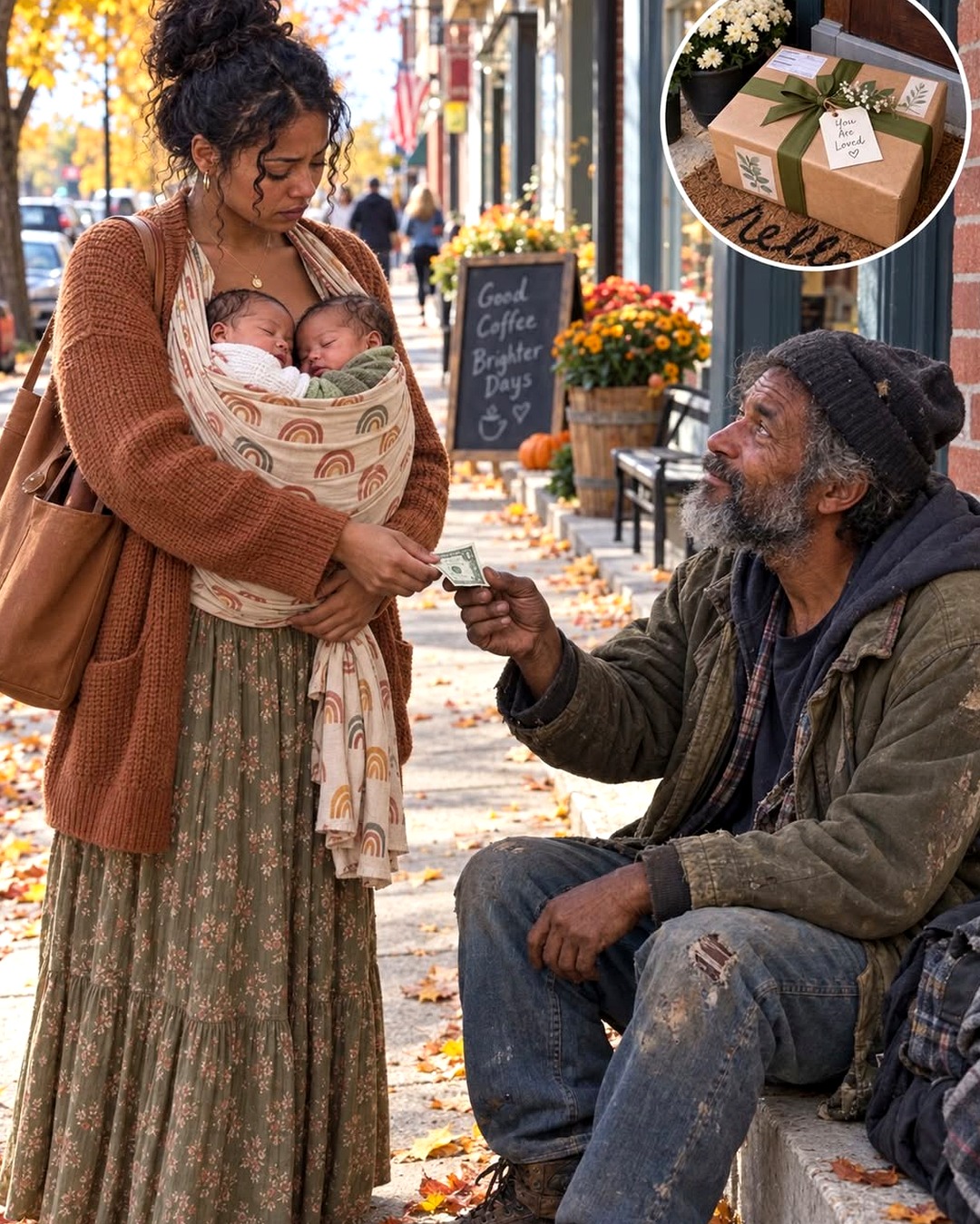
I gave my last $10 to a homeless man in 1998. Decades later, a lawyer walked into my office carrying a box, and the moment I opened it, I broke down in tears. I was seventeen when I had my twins. Seventeen, broke, exhausted, and still an honor student. Because I believed if I worked hard enough, life would eventually give me a chance. My parents didn't believe that. They said I had ruined everything. They cut me off completely. No help. No home. By November 1998, I was a student and a mother of two babies I carried in a worn sling against my chest, living on instant noodles and night shifts at the library. That night, it was pouring in Seattle. I had exactly $10 left. Bus fare. Bread. Three days of survival. Then I saw him. An older man under a rusted awning, soaked through, shaking so hard it hurt to watch. No sign. No voice. Just invisible. I knew that feeling. Without thinking, I pressed that last $10 into his hand. "Please," I whispered. "Get something warm." He looked at me. Really looked. The way almost nobody had looked at me in months, like I was a whole person and not a problem. And for some reason, I asked, "What's your name?" There was a long pause. His mouth worked, like the word had gone rusty. Then, quietly, he said, "Samuel." "It's nice to meet you, Samuel," I said.
"I'm Elena." He stared at me like I’d handed him something far bigger than ten dollars. I nodded, like it mattered somehow. Then I walked three miles home in the rain, holding my babies close so they wouldn't get wet. I remember thinking I was stupid. That I couldn't afford kindness. Twenty-seven years passed. I'm forty-four now. My girls are grown, but life never got easier. One of them got seriously ill two years ago. Surgeries. Treatments. Bills that kept piling up no matter how hard I worked. I was drowning all over again. This morning, I sat at my desk staring at another overdue notice when a man in a charcoal suit walked in. "Are you Elena?" he asked. My chest tightened. He set an old, weathered box on the desk in front of me. "I represent the estate of Samuel," he said. "He spent years trying to find you." "He asked me to give this to you personally." My whole world tilted. Samuel. The man I'd met for thirty seconds in 1998. "He left instructions," the lawyer said. "This was meant for you alone." The box opened with a soft creak. And inside, folded in a square of yellowed wax paper, was a ten-dollar bill. My ten-dollar bill. He had kept it for twenty-seven years. I burst into tears. Because the homeless man I gave my last $10 to was not who I thought he was at all.
The Weight of a Memory
The lawyer, a Mr. Harding, cleared his throat. “Mrs. Rossi, Samuel wasn’t… entirely without resources. He was a very private man, but a successful one. A tech pioneer, actually. He sold his company in the early 2000s, but continued to live a very simple life.” I wiped my eyes, still trying to comprehend. Samuel, a tech pioneer? The man I remembered was shivering, barely able to speak. "He insisted on a specific clause in his will," Mr. Harding continued, his voice gentle. "That this box, and its contents, be delivered to you, and you alone. He said… he said you reminded him of something he’d lost.” I reached for the bill, my fingers trembling.
It was faded, worn, but unmistakably *my* ten dollars. The one I’d sacrificed for a fleeting moment of connection. “He also left a letter.” Mr. Harding handed me a sealed envelope, the paper brittle with age. The return address was a post office box in Bellevue, Washington. I hesitated, afraid of what the letter might contain. Afraid that the truth would be too much to bear. My assistant, Sarah, peeked in, concern etched on her face. “Everything alright, Elena?” I forced a smile. “Just… a complicated delivery.” I needed to be alone with this. This wasn’t just about a ten-dollar bill; it was about a lifetime of struggle, a single act of kindness, and a mystery that was beginning to unravel.
Then came the shocking detail that changed the entire story forever… (Continue to Part 2 →)