I stood in the kitchen with a cup of coffee gone cold. The chipped ceramic warmed my hands, but did nothing for the chill that had settled deep in my bones. It wasn’t the November air seeping in around the window frames, though that certainly didn't help. It was the coldness of my own family. “The garage?” I asked, my voice barely a whisper. “It’s freezing out there.”
Dad lowered his newspaper, the rustling sound unusually loud in the silent kitchen. “Stop complaining, Amelia. Your sister explained the situation.” His tone brooked no argument. He hadn’t asked how *I* was doing, hadn’t acknowledged the grief that still clung to me like a shroud, hadn’t even met my gaze. It had been nine months since Wes died, nine months since the world had lost its color, and nine months since they'd started treating me like a ghost in their own home.
Mom kept stirring her coffee, her expression carefully neutral. “Ryan has important meetings, sweetheart. Be considerate.” Considerate. The word tasted like ash in my mouth. This house, this comfortable life, had been bought with Wes’s blood, sweat, and sacrifice. He’d purchased it after his second deployment, a safe haven for my parents. He’d covered Chloe’s exorbitant law school tuition, silently and without complaint. He’d even paid off their mounting medical debts. And now? They were rearranging things for Ryan’s “important meetings.”
Chloe swept in, a whirlwind of silk pajamas and expensive perfume, holding her miniature Pomeranian, Princess Fluffernutter. “It’s temporary, Amelia. Ryan needs somewhere quiet. He’s on a crucial deal.” Her husband, Ryan, trailed behind her, a smirk playing on his lips. “Besides,” he drawled, “all this constant sadness is getting exhausting. It’s a real downer for business.”
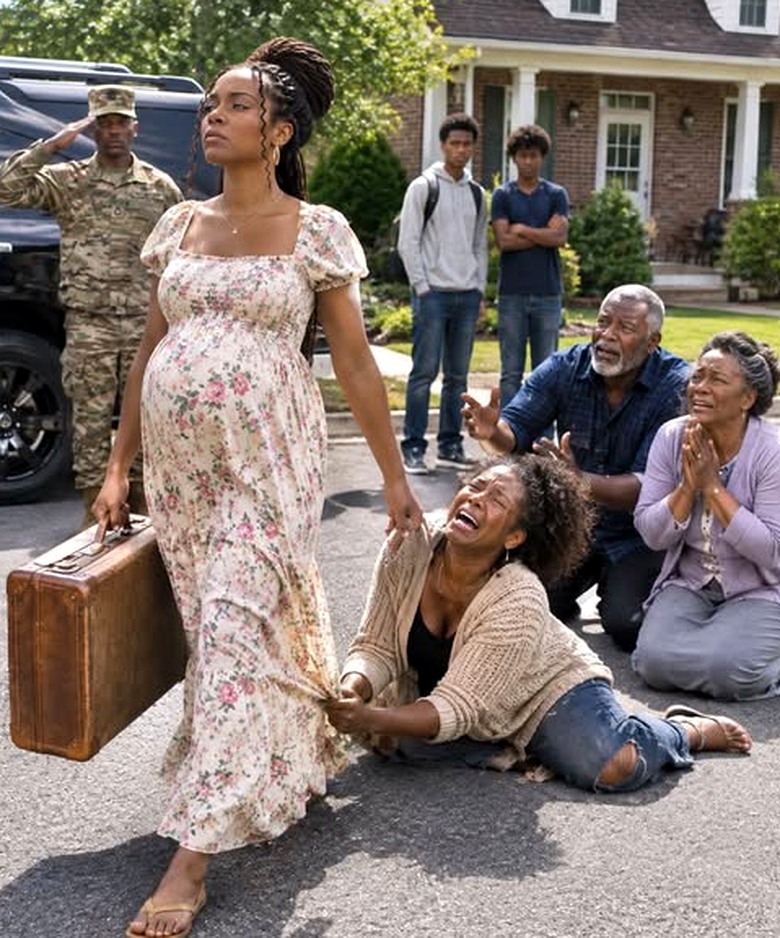
My stomach tightened, a familiar ache blossoming with the baby’s movement. “My husband died serving his country,” I said, my voice shaking despite my best efforts. I was seven months pregnant, vulnerable, and utterly alone.
Ryan shrugged, a dismissive gesture that felt like a slap. “Everybody’s got problems.” Mom finally looked at me, her gaze devoid of warmth. “Just don’t scatter your things around, Amelia. Ryan keeps his Mercedes in there.” The Mercedes. Of course. Their priorities were perfectly clear. Nobody looked embarrassed. Nobody offered to help. For months they’d mocked my grief, questioned my ability to raise a child alone, complained I spent too much time on my laptop. They had no idea what I was actually doing. And I no longer intended to explain.
“Fine,” I said quietly, a steely resolve hardening within me. I packed a small suitcase, choosing only the essentials: two warm coats, some maternity clothes, my laptop, and Wes’s dog tags. They were the only tangible piece of him I had left. The garage smelled of damp concrete and motor oil. A rusted folding cot sat against the back wall, covered with a thin, threadbare blanket. No heat. No bathroom. Almost no room to move. I lowered myself onto the cot as the baby kicked, and I put a hand over my belly. “It’s okay, sweetheart. Mommy’s going to figure this out.”
Then my secure phone buzzed, a lifeline in the darkness. I glanced at the screen. Transfer confirmed. Project Orion approved. Defense contract finalized. Transport scheduled: 0800. Welcome to Stratix Defense Systems, Mrs. Carter. Tears welled up in my eyes—and for the first time in nine months, they weren’t all grief. Because my family’s greatest mistake was assuming that losing Wes had left me with nothing, and just as I was beginning to feel a flicker of hope, a roar of engines shattered the morning stillness, and three black military SUVs pulled into the driveway.
Before anyone could say another word, my phone lit up with a message that changed everything in an instant.