
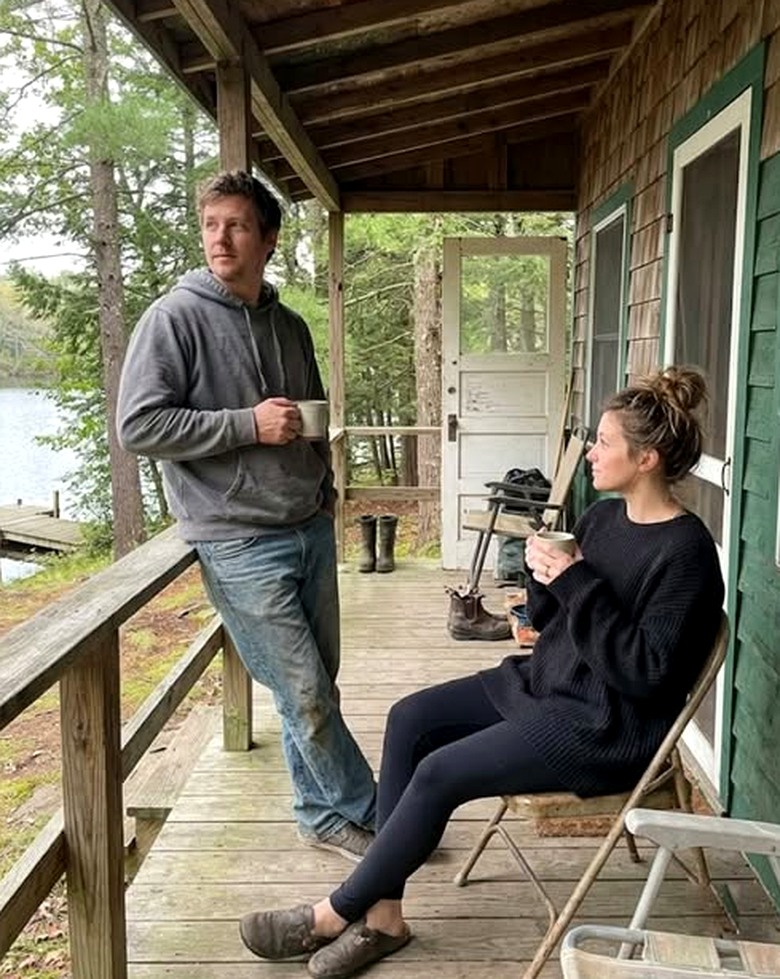
My parents gave my brother the family vacation home, the house I grew up spending every summer in. He sent me a list of "approved visit dates." I read it twice. Then I blocked his number. Six months later, Mom called asking why I skipped Thanksgiving.
“You skipped Thanksgiving because of the lake house?”
My mother’s voice came through the phone sharp enough to cut glass. She was furious that I hadn’t appeared for dinner. She wasn’t asking whether I was okay.
“Mom,” I said, “Sutton needs to approve the dates when I’m allowed through the door. But you still expect me to show up whenever you call?”
She went silent. Then came the familiar command: “Oliver, that was months ago. You need to let it go.”
My name is Oliver. I’m thirty-four, a structural engineer from western Pennsylvania, and the house we were arguing about wasn’t some rental property. It was the place my grandfather Hank promised would always be there for me.
Every childhood summer, we spent three weeks at that three-bedroom cabin on Racetown Lake. Its porch leaned left. Its old kitchen had avocado-green appliances. The dock complained beneath our feet, but I loved every inch of it.
Grandpa taught me fishing knots and how to recognize trees by their bark. He never cared that I preferred chess and science fiction to baseball. My father, Jean, lived for baseball. And my younger brother, Sutton, was his favorite player in every sense.
Sutton was funny, charming, loud. I was the reliable one, good at school, easy to overlook. My parents loved me. They just seemed to light up whenever he walked into a room.
At the lake, none of that mattered. Grandpa looked directly at me when I spoke. He remembered what I liked. When I was twelve, he told me the cabin would always be there for me.
Grandma Dela died when I was twenty-two. Grandpa followed four years later. After his funeral, I sat on that creaking dock for three hours because I couldn’t imagine losing him and the place that still felt like him.
His will left the property to Mom, Loretta, his only child. For several years, our summer tradition continued. I thought it always would.
Then Sutton married Jolene.
Jolene saw real estate differently. Where I remembered fishing at sunrise, she saw property value, renovations, and potential returns. Soon Mom began praising Sutton’s financial plans and mentioning that the lake house needed someone to care for it.
One Sunday in October, my parents invited us to dinner. Mom served roast, mashed potatoes, and her lemon pie. But the air was thick with unspoken tension. Sutton and Jolene discussed their plans for the lake house, and Mom listened with a nod of approval.
“So, you’re thinking of turning it into a rental property?” I asked, trying to keep my voice neutral.
“Absolutely,” Sutton replied, his eyes alight with excitement. “We can make a fortune. And it’ll be a lot less hassle for everyone.”
“Hassle?” I repeated, feeling the words stick in my throat. “This isn’t just a piece of property. It’s a place where we made memories. Where we spent summers together. Where Grandpa taught me how to fish.”
Sutton’s smile faltered. “Oliver, things change. We’re just trying to make the best of it.”
Mom’s gaze shifted between us, her expression unreadable. “Oliver, maybe Sutton and Jolene are right. It’s time to move on.”
The words hit me like a punch to the gut. “Move on? This place means everything to me. It’s part of who I am.”
Jolene interjected, her voice smooth and calculated. “Oliver, we understand it’s emotional, but we’re doing what’s best for the family. You’ll always be welcome to visit.”
“Welcome to visit?” I repeated, my voice rising. “This isn’t a hotel. This is our family home. My home.”
The tension in the room was palpable. My father, usually the peacemaker, remained silent, his eyes avoiding mine.
“Oliver, that’s enough,” Mom said, her tone final. “We’ve made our decision.”
Before anyone could utter another word, the heavy oak door swung open—and what was revealed next left the entire room dead silent.